
The Story Behind the Image
Thank you for choosing one of my images.
What you see here is the result of time. Time spent in the field, returning to the same places again and again, often in less-than-ideal conditions, waiting for light, behavior, and moment to align. This body of work was created over the course of nearly three years, shaped by countless mornings, changing seasons, and thousands of frames captured along the way.
Each photograph represents more than a single moment. It reflects patience, observation, and a deep respect for the natural world. The goal has always been to go beyond simply documenting wildlife, and instead create images that feel quiet, intentional, and emotionally grounded; photographs meant to be lived with, not just viewed.
Below, you will find the story behind the specific image you purchased, the identity of the subject, what was happening in that moment, why it caught my attention, and what made it worth waiting for.
I hope it adds another layer of meaning as you enjoy the piece in your space.
Owners of my work are invited to join the Collector List for early access to new releases and field notes from the road.
Join the Collector List
Curtsy
Black-necked Stilt (Himantopus mexicanus)
In June of 2024, I had the rare opportunity to follow a family of Black-necked Stilts at the Gilbert Riparian Preserve from nesting through the early days of raising their young. Over the course of several weeks, I was able to observe and photograph the chicks as they took their first steps into the world.
This image captures one of those early moments, as a young stilt instinctively lifted its wings in a gesture that resembled a quiet curtsy. The calm water and soft light created a natural reflection, emphasizing both balance and symmetry in the scene.
This photograph has received multiple national photography awards and was featured on the cover of National Wildlife magazine, Winter 2026.
Introduction
Black-necked Stilt (Himantopus mexicanus)
Photographed just days after Curtsy, this image captures a young Black-necked Stilt stepping into one of its earliest lessons in independence. Still unsteady and covered in soft down, the chick became fixated on a small insect hovering just beyond its beak — a fleeting interaction that lasted only a moment.
What drew me in immediately was the visual alignment. The glowing bokeh fell precisely at the intersection of the chick’s beak and the insect, quietly anchoring the frame and heightening the sense of connection between the two. For an instant, curiosity and instinct appeared suspended in perfect balance.
Working from a low perspective in the early light allowed the scene to simplify, isolating both subject and behavior while emphasizing the bird’s delicate structure and forward posture. The raised leg hints at movement, but the image itself holds a quiet tension, the space between attempt and outcome.
Selected as a finalist in the 2025 National Wildlife Federation Photography Competition, this photograph remains a powerful reminder that some of the most meaningful wildlife moments unfold in fractions of a second, where timing, awareness, and visual harmony come together.
Curious
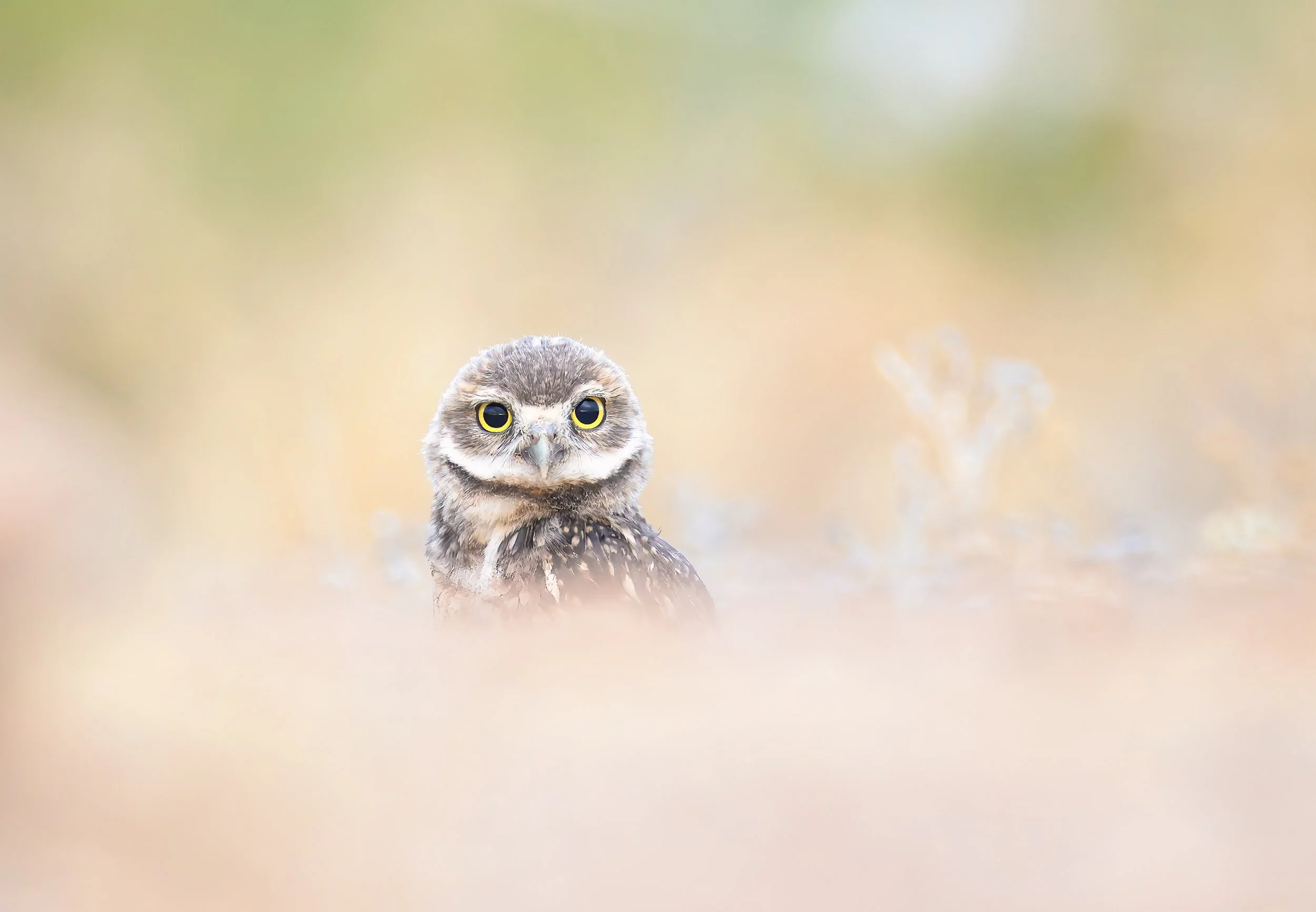
Burrowing Owl (Athene cunicularia)
Photographed in Scottsdale, Arizona during the summer of 2024, this image captures a young Burrowing Owl peering cautiously from its burrow, its wide eyes fixed with quiet curiosity.
What drew me to this moment was not only the owl’s expression, but the opportunity to photograph it through the surrounding vegetation. I deliberately worked from a very low perspective, allowing the blurred foreground to soften the frame and naturally isolate the bird. Shooting through foliage is a technique I return to often as it simplifies the scene, removes distraction, and creates a more intimate connection between subject and viewer.
Rather than fully revealing the environment, the gentle veil of color guides the eye directly to the owl’s gaze, giving the image a calm, immersive quality. The result feels less like an observation from a distance and more like a brief, shared moment of awareness.
Images like this reinforce my belief that how we choose to see a subject is just as important as the subject itself.
Solitude
Black-necked Stilt (Himantopus mexicanus)
Photographed in Gilbert, Arizona during the late afternoon of spring 2025, this image was created as the sun lowered toward the western horizon. A thin layer of passing clouds softened and directed the light, allowing it to fall selectively across the scene.
The photograph was intentionally composed as a low-key image, using shadow and negative space to isolate the subject and draw attention to its quiet posture. Standing alone in shallow water, the stilt appears suspended in stillness, emphasizing both balance and solitude.
This image was created with the intention of letting simplicity and light define the moment, allowing the subject to emerge naturally from the darkness.
Peek-A-Boo
Lincoln’s Sparrow (Melospiza lincolnii)
Photographed in Gilbert, Arizona during the spring of 2025, this image came together unexpectedly while I was observing a group of birders attempting to photograph a rare species nearby. As their attention remained fixed in one direction, I noticed a small group of Lincoln’s Sparrows feeding quietly among the flowering plants beside me.
What caught my eye was the way the birds would dip down into the blossoms and then suddenly lift their heads, briefly revealing themselves before disappearing again. The soft colors, layered textures, and contrast between the background, subject, and foliage immediately stood out.
I set up and waited, allowing the moment to unfold naturally. When the sparrow finally emerged at just the right angle, the scene came together in a way that felt both playful and serene.
Dead Ahead
Western Grebe (Aechmophorus occidentalis)
Photographed in Gilbert, Arizona in October of 2024, this image captures a rare and memorable encounter with a Western Grebe. These birds are uncommon visitors to Arizona, making their presence an unexpected and welcome surprise.
After spending several days observing and photographing the pair, I set out one morning with a specific goal in mind, to capture a head-on perspective that emphasized symmetry, posture, and intensity. Positioning myself low along the shoreline, I waited as the light and the bird’s movement aligned.
When the grebe surfaced and moved directly toward me, the moment came together in perfect balance. The calm water, centered composition, and direct gaze created an image that feels both intimate and commanding.
Entangled
Snowy Egret (Egretta thula)
Photographed in Gilbert, Arizona in June of 2023, this image came from a series of early morning visits to the same location during peak breeding season. Snowy Egrets are highly territorial at this time of year, and repeated visits allowed me to anticipate their behavior and patterns.
Arriving before sunrise, I set up along the shoreline knowing that interactions between competing males were likely. What unfolded was a brief but intense aerial encounter as two birds engaged mid-air, their wings and plumes colliding in a moment that appeared almost choreographed.
At the time, I was unaware of just how perfectly the moment had aligned. It wasn’t until reviewing the images later that I realized the two birds appeared locked together in what looked more like a dance than a confrontation.
This photograph went on to receive multiple national photography awards, including Best in Show at the Hit Me With Your Best Shot National Photo Exhibition hosted by the Gallery by the Lake, Lake Charles, LA in 2023.
Siblings
Burrowing Owl (Athene cunicularia)
Photographed in Scottsdale, Arizona in June of 2023, this image captures two young Burrowing Owls emerging together from their burrow. Still in their early stages of development, the pair moved cautiously through the surrounding grasses, pausing often to observe their surroundings.
What drew me to this moment was the quiet interaction between them, two nearly identical expressions, framed closely together, both alert and curious. The soft foreground and muted tones helped isolate their faces, emphasizing the bond and shared awareness that often defines these early weeks of life.
Moments like this are brief, but they offer a glimpse into the subtle relationships that form long before the birds are fully independent.
Reflections in Harmony
American White Pelican (Pelecanus erythrorhynchos)
Photographed in Gilbert, Arizona in late December of 2024, this image was created on a quiet winter morning as the sun began to rise over the water. American White Pelicans are common in the area during this time of year, and while I do not often seek them out, the conditions that morning created something unexpected.
As the light broke through the clouds, I noticed two pelicans standing together in perfect alignment near the center of the pond. The soft, directional light illuminated their white plumage while the surrounding shadows fell away, creating a natural sense of balance and calm.
The still water mirrored the moment, and for a brief window everything aligned, light, subject, and reflection, creating a scene that felt both peaceful and deliberate. It was one of those quiet moments that reminds you why patience in the field matters.
Desert Hymn
Cactus Wren (Campylorhynchus brunneicapillus)
Photographed in the spring of 2025 at Lost Dutchman State Park in Apache Junction, Arizona, this image was created during the quiet moments just after sunrise, when the desert is washed in soft purples, pale blues, and warm pastel tones. It is a kind of light unique to the Southwest, subtle, fleeting, and impossible to recreate.
Perched atop a dense cholla cactus, the cactus wren appears calm and unbothered, framed by the gentle color of the morning sky. The contrast between the softness of the light and the harshness of the cactus tells a familiar desert story. What looks serene from a distance is, in reality, a landscape shaped by resilience.
The scene came together naturally; light, color, and subject aligning for a brief moment , capturing the quiet beauty that defines the desert at dawn.
Delicate Balance
Racket-tailed Hummingbird (Ocreatus sp.)
Photographed in 2024 during an eight-day journey through Ecuador, this image was captured in the upper Amazon Basin, a region rich with biodiversity and home to an extraordinary variety of hummingbirds.
Hovering effortlessly beside a vibrant bloom, the racket-tailed hummingbird appears suspended in midair, its elongated tail streamers trailing behind in perfect balance. The soft, luminous background and warm tropical light helped isolate the subject, allowing the subtle iridescence of the bird to stand out against the surrounding color.
Moments like this are fleeting. The bird paused only briefly before darting away, but in that instant, light, motion, and form aligned, a reminder of the precision and grace that define these remarkable creatures.
Hovering Grace
Lesser Violet-ear (Colibri cyanotus)
Photographed in 2024 in the upper Amazon Basin, this image captures a fleeting moment of balance and control as a Lesser Violet-ear hovers effortlessly beneath a flowering vine. The soft, dark background allowed the bird’s iridescent greens and blues to stand out, while the subtle blur of its wings hints at the constant motion required to remain suspended in place.
The scene unfolded quietly. The bird approached the bloom with precision, pausing just long enough for the light, color, and form to align. Moments like this are measured in fractions of a second, yet they reveal the remarkable grace and efficiency of these tiny travelers.
It was a reminder of how much beauty exists in the smallest, most fleeting interactions within the natural world.
The Sword and the Bloom
Sword-billed Hummingbird (Ensifera ensifera)
Photographed in 2024 during a trip to Ecuador’s cloud forest, this image was created with a very specific vision in mind. The sword-billed hummingbird is one of the most extraordinary hummingbirds in the world, known for a bill longer than its own body — perfectly adapted for feeding from deep, tubular flowers.
We positioned ourselves carefully, waiting for the moment when bird and bloom would align. When it happened, the scene unfolded exactly as envisioned: the long, straight bill forming a striking vertical line, intersecting with the delicate bloom below.
The contrast between strength and fragility, precision and softness, is what defines this image. What appears almost surreal is, in fact, a perfect example of coevolution, a bird and flower shaped by one another over time.
Graceful Elegance
Black-necked Stilt (Himantopus mexicanus)
Photographed in the summer of 2023 at a local riparian preserve, this image came together as I walked along the edge of a pond and noticed the soft sidelight catching a pair of wading Black-necked Stilts. The angle of the light created a natural separation between subject and background, immediately drawing my attention to the bird’s form and movement.
I chose to photograph this scene using a low-key approach, allowing the surrounding shadows to fall away while emphasizing the subtle highlights along the stilt’s body and legs. The result is an image that feels quiet and refined, where light and posture work together to convey a sense of balance and calm.
Moments like this are a reminder of how powerful simple light can be when everything aligns just right.
Surface Tension
Green-winged Teal (Anas crecca)
Photographed in Gilbert, Arizona during the spring of 2024, this image was made on one of the rare cloudy mornings the desert occasionally offers. Overcast conditions like these are ideal for photographing Green-winged Teals, as the soft, diffused light eliminates harsh shadows and allows subtle color and texture to come through.
As the teal moved quietly across the water, the calm surface and muted sky created a sense of stillness that felt almost suspended in time. The lack of contrast allowed the form and reflection of the bird to take center stage, emphasizing simplicity and balance over drama.
Days like this are easy to overlook, but they often provide some of the most rewarding light for thoughtful, intentional photography.
Bubbles
Green-winged Teal (Anas crecca)
Captured in the spring of 2023 on a rare rainy morning in Gilbert Arizona, this image highlights the quiet beauty that comes with overcast conditions. Light rain dotted the surface of the water as this Green-winged Teal moved slowly through the frame, creating a soft trail of ripples and bubbles behind it.
These subdued days are some of my favorites to photograph. The diffused light softens reflections, enhances subtle color, and allows the scene to feel calm and intimate. In moments like this, the environment does the work for you, all that’s left is patience and observation.
Drift
Green-winged Teal (Anas crecca)
Photographed in Gilbert, Arizona during the winter of 2026, this image was captured on another quiet, overcast morning when the desert sky softened the landscape below. Cloud cover like this creates ideal conditions for waterfowl photography, muting reflections and allowing fine detail and color to surface without distraction.
As the teal drifted across the pond, the water remained glassy and still, creating a sense of calm that felt almost suspended in time. The subdued tones of the morning allowed the subtle greens and warm chestnut of the bird’s head to stand out naturally, without the need for dramatic light.
This image is less about motion and more about presence. A reminder that some of the most compelling moments happen when everything slows down.
Poise
Green-winged Teal (Anas crecca)
Captured moments after Drift, this image shows a male Green-winged Teal rising slightly out of the water in a brief display of courtship behavior. Photographed in Gilbert, Arizona during the winter of 2026, the soft, overcast light once again played a key role in shaping the mood of the scene.
The gentle lift of the body and the subtle turn of the head are part of a quiet ritual meant to attract attention. Without harsh shadows or contrast, the posture and gesture become the focus, allowing the behavior itself to tell the story.
Cloudy days often go unnoticed by photographers, but for scenes like this, they offer an unmatched opportunity to capture nuance, texture, and emotion in its most natural form.
Soft Ritual
Cinnamon Teal (Spatula cyanoptera)
Photographed in Gilbert, Arizona on a cloudy, rain-softened afternoon, this image captures a quiet moment in the daily rhythm of a Cinnamon Teal. Overcast conditions like these are ideal for photographing waterfowl, as the muted light reveals subtle color and texture without harsh contrast.
As the teal paused to preen, the calm surface of the water and diffused sky created a gentle, almost painterly atmosphere. The subdued light allowed the warm cinnamon tones to stand out naturally, emphasizing the bird’s form without overpowering the scene.
Moments like this are easy to overlook, but they often reveal the most intimate behaviors. The stillness, the repetition, and the quiet focus of the bird reflect the kind of subtle beauty that cloudy days so often provide.
Line of Intent
Cinnamon Teal (Spatula cyanoptera)
Photographed in Gilbert, Arizona during the spring of 2025, this image captures a moment of quiet intensity on a rainy morning. Overcast conditions once again played a key role, softening the light and allowing the rich cinnamon tones of the teal to stand out against the muted green background.
What drew me to this moment was the directness of the bird’s posture. The head-on perspective creates a strong sense of focus and purpose, as if the teal were cutting a clean line through the water. The reflection and symmetry reinforce that feeling, drawing the eye straight to the subject.
Rainy days like this often go unnoticed, but they offer some of the most rewarding conditions for photographing waterfowl. The contrast between subtle color, calm water, and focused movement creates a quiet intensity that feels both deliberate and fleeting.
Quiet Ritual
Northern Shoveler (Spatula clypeata)
Photographed in Gilbert, Arizona during the spring of 2023, this image reflects my continued draw toward minimalism and calm, uncluttered scenes. Smooth water, soft light, and clean backgrounds create the kind of simplicity that allows subtle moments to stand on their own.
As the Northern Shoveler moved through its routine preening ritual, the stillness of the water and muted tones of the morning created a sense of quiet balance. The reflection, the gentle curve of the bird’s posture, and the absence of distraction all worked together to elevate what is normally an everyday behavior into something more deliberate and expressive.
Moments like this are easy to miss, but they often become the most meaningful. The calm, the repetition, and the understated motion speak to the beauty found in stillness, a reminder that not every powerful image needs action to hold attention.
Suspended in Light
House Finch (Haemorhous mexicanus)
Photographed in the spring of 2025, Suspended in Light captures the subtle beauty of a common house finch illuminated by soft, diffused light. The gentle pastel tones of the background contrast beautifully with the warm reds and grays of the bird, creating a sense of separation and calm.
What drew me to this moment was the way the light interacted with the scene. The delicate balance between color, softness, and form allowed the finch to stand out without overpowering the frame. Perched lightly among the stems, the bird appears almost weightless, suspended within the glow of the morning.
This image reflects my ongoing pursuit of quiet moments, where light and subject come together naturally to tell a simple, elegant story.
A Place to Settle
Cactus Wren (Campylorhynchus brunneicapillus)
Photographed in the winter of 2026 in the Sonoran Desert of Arizona, this image captures a Cactus Wren resting naturally among the dense spines of a cholla cactus, a setting that appears harsh, yet serves as both shelter and home.
What immediately drew me to this moment was the way the backlit feathers of the wren echoed the cactus spines surrounding it. For an instant, bird and plant seemed visually intertwined, the glowing edges of each blending together in the morning light. Rather than standing apart from its environment, the wren felt seamlessly shaped by it.
I positioned myself to preserve that relationship, allowing the cactus to frame the bird while a soft background kept the scene quiet and uncluttered. The result is less about contrast and more about connection — a reminder that in the desert, survival often depends on becoming part of the landscape itself.
Images like this reinforce something I am continually drawn to: the subtle ways wildlife belongs exactly where it is, even in places that might feel unwelcoming to us.
Between the Drops
Neotropic Cormorant (Nannopterum brasilianum)
Photographed in the winter of 2025 in Gilbert, Arizona, this image was created on one of those rare rainy days that instantly draws me into the field. Overcast skies and soft, muted light transform familiar places, and the subdued pastel tones that emerge in these conditions are some of my favorite to work with.
I often shoot from extremely low angles in situations like this, using foreground blur to create depth and atmosphere, sometimes placing the camera directly on the ground to achieve the perspective I am after. In this moment, the falling rain, soft focus, and calm posture of the Neotropic Cormorant came together naturally.
The raindrops add a quiet sense of motion and mood, while the contrast between the bird and the softened background gives the image its presence. It is a reminder that some of the most compelling moments happen when conditions are less than perfect.
Caught in the Light
Yellow-rumped Warbler (Setophaga coronata)
Photographed in the winter of 2026, this image was made while walking back toward my vehicle after a morning in the field, at a moment when I thought the best light had already passed. Along the path, a small group of Yellow-rumped Warblers were feeding quietly among the blossoms.
Soft back light began filtering through the foliage, catching the birds at just the right angle and illuminating the delicate textures of the leaves and seed heads. The light transformed an otherwise ordinary scene into something far more compelling.
I paused and waited, letting the birds move naturally through the space rather than chasing the moment. When this warbler settled briefly in the open, the balance of light, subject, and background came together on its own.
Images like this are a reminder that the best light often appears when you are least expecting it, and that slowing down and staying observant can turn an ending moment into one of the strongest of the day.
Flare and Flight
Rufous-tailed Hummingbird (Amazilia tzacatl)
Photographed in September of 2024 in the cloud forest of Ecuador, this image was made while sitting quietly in a flower garden, watching Rufous-tailed Hummingbirds move steadily between blossoms. The constant motion and vibrant color made the scene captivating, but I had a very specific moment in mind.
I was drawn to the brief instant when the hummingbird’s tail flares open as it feeds, a detail that often goes unnoticed due to how quickly it happens. I intentionally slowed my shutter speed just enough to allow motion to remain in the wings while keeping the body sharp, balancing movement with detail. Rather than chasing the birds, I set my gear and stayed still, letting them return naturally to the flowers.
When this hummingbird hovered in the right position, its tail fully expanded and wings suspended in motion, the moment came together exactly as I had hoped. The rich greens, deep oranges, and saturated purples reflect the incredible color and energy of Ecuadorian hummingbirds, and serve as a reminder that patience often reveals details that movement alone can miss.
Steely Gaze
Cooper’s Hawk (Accipiter cooperii)
Photographed in Gilbert, Arizona during the winter of 2024, this image was made while walking along a path at the local riparian preserve. I noticed this Cooper’s Hawk standing quietly in the creek, appearing to bathe in the shallow water and seemingly unfazed by my presence.
I slowly dropped to the ground and stayed still, allowing the hawk to continue what it was doing without interruption. From that low perspective, the soft foreground and muted background helped isolate the bird and draw attention to its posture and expression.
This image stood out to me because of the intensity of the hawk’s gaze and the near symmetry of its head. The direct eye contact, combined with subtle feather detail and calm body language, gives the image a quiet tension that held my attention long after the moment passed.
Glide Path
Burrowing Owl (Athene cunicularia)
Photographed in Scottsdale, Arizona during the spring of 2025, this image was made after noticing a Burrowing Owl perched quietly on a roadside sign. Moments like this often signal what is coming next, and I knew the owl would eventually take flight.
Rather than reacting when it happened, I positioned myself and my camera ahead of time, anticipating the direction and height of its departure. When the owl finally launched, it passed cleanly through the frame, wings tucked and body level, creating a smooth and controlled glide.
Burrowing Owls are one of my favorite species to photograph. Their behavior is expressive, their flight is purposeful, and their willingness to linger often allows for moments like this, where patience and preparation come together in a single, quiet pass through the light.
Through the Veil
Burrowing Owl (Athene cunicularia)
Photographed in Scottsdale, Arizona during the spring of 2024, this image was made while observing Burrowing Owls in their natural surroundings. As I watched one individual, I noticed it partially concealed behind an obstacle, with only the top of its head and a single eye visible.
That limited view immediately caught my attention. Rather than waiting for the owl to step fully into the open, I chose to work with what was revealed. My intent was to frame the bird in a way that suggested it was peeking out from a hidden space, allowing curiosity and subtlety to drive the image.
The soft foreground and smooth, muted background help isolate the owl’s eye and expression, creating a quiet sense of tension and intimacy. This image remains one of my favorites because it shows how restraint, patience, and careful framing can often say more than a fully revealed subject
Wild and Free
Salt River Wild Horses (Equus ferus caballus)
Photographed along the Salt River in Arizona during the winter of 2022, this image marks the beginning of my journey into wildlife photography. After spending most of my life focused on landscapes, I set out on my first visit to see the Salt River Wild Horses, unsure of what I would encounter or how the experience would unfold.
What I found was far more powerful than I had anticipated. Watching these horses move freely through the desert landscape was captivating, their strength, motion, and presence impossible to ignore. As dust rose around them and their interaction intensified, the scene felt raw and untamed, unlike anything I had photographed before.
This moment, captured as two horses collided in a brief display of dominance and energy, changed the way I saw photography. It shifted my focus from places to presence, from scenery to story, and set me on a path toward photographing wildlife in a more intentional and immersive way.
White Thunder
Salt River Wild Horses (Equus ferus caballus)
Photographed in the Arizona desert during the spring of 2023, this image was made while observing a band of Salt River Wild Horses moving quietly through the landscape. As I focused on the group ahead of me, I suddenly heard movement behind me. Turning quickly, I saw this striking white horse rising from the ground after resting in the cool shade.
The moment unfolded without warning. Dust lifted softly around the horse as it gathered itself, its mane catching the light and creating a natural halo that immediately drew my eye. There was a sense of power in the motion, balanced by an equally strong feeling of awareness as the horse fixed its attention forward.
Encounters like this are a reminder that wildlife photography often rewards attentiveness as much as preparation. Sometimes the image is not in front of you, but waiting just beyond your field of view, revealed only when you remain present to the surroundings.
Balance
Gilded Flicker (Colaptes chrysoides)
Photographed in 2024 in the Sonoran Desert, this image was made after spending considerable time tracking a Gilded Flicker through the desert landscape. These birds are often found perched high atop saguaro cacti, where distance and elevation can make a clean composition difficult to achieve.
My patience was rewarded when this flicker settled onto a nearby branch at eye level. I quietly adjusted my position, paying close attention to the relationship between the bird and the background, allowing the soft desert colors to fall smoothly out of focus.
Perched with quiet steadiness, the flicker seemed perfectly at ease, embodying a sense of natural balance that immediately drew me in. Images like this are often less about reaction and more about persistence, reminding me that time in the field is rarely wasted when you are willing to wait for the right alignment of subject, light, and space.
The Space Between
Least Sandpiper (Calidris minutilla)
Photographed in Gilbert, Arizona during the winter of 2025, this image reflects my continued draw toward simplicity and restraint when working with shorebirds. While I have long been captivated by waders, the Least Sandpiper remains one of my favorite species to photograph. Despite their small size, these birds travel remarkable distances during migration, moving with a coordination and awareness that is both efficient and fascinating to observe.
There is a rhythm to the way they feed and travel together, a subtle communication that often feels almost choreographed. Moments like these invite a quieter approach behind the camera.
When creating this image, I intentionally used both foreground and background elements to soften the scene and frame the bird within a wash of color. The minimal composition allows space for the subject to exist without distraction, drawing attention to its delicate posture and reflection.
Images like this remind me that not every photograph needs complexity. Sometimes the strongest visual impact is found in the space surrounding the subject, where light, color, and stillness are allowed to speak just as clearly as the bird itself.
The Quiet Sip
Greater Yellowlegs (Tringa melanoleuca)
Photographed in Gilbert, Arizona during the winter of 2025, this image was created during the same early morning conditions that often bring a sense of calm to the shoreline. As the light softened across the water, this Greater Yellowlegs moved steadily through its feeding routine, pausing briefly for a quiet sip.
I worked from a low perspective and intentionally used both foreground and background elements to frame the subject, allowing the surrounding color to dissolve into a smooth, unobtrusive wash. This approach helps guide the eye gently toward the bird while preserving the stillness of the scene.
What drew me to this moment was its simplicity. There was no urgency, no sudden movement, just a solitary bird, soft light, and a near-perfect reflection. Images like this remind me that some of the most compelling photographs are not defined by action, but by the quiet rhythm of behavior unfolding exactly as it should.
Emergence
Brown Pelican (Pelecanus occidentalis)
Photographed along the coastline of Santa Cruz, California during the summer of 2025, this image captures a Brown Pelican slowly revealing itself from behind a coastal rock. What first appeared as an indistinct shape gradually took form as the bird stepped forward, its presence emerging softly through the surrounding haze.
I was drawn to the layered foreground, which allowed only part of the pelican to be seen at first. Rather than repositioning for a completely unobstructed view, I chose to work with the natural elements in front of me, letting them obscure portions of the frame and simplify the scene.
The result is an image built on subtlety, where suggestion carries more weight than full disclosure. The muted tones, minimal palette, and gentle transition between subject and space create a quiet mood that mirrors the calm rhythm of the coastline.
Images like this remind me that not every subject needs to be fully revealed. Sometimes what is partially hidden invites the viewer to slow down, look longer, and discover the photograph in stages.
Perched in Light
Cactus Wren (Campylorhynchus brunneicapillus)
Photographed in the Sonoran Desert during the spring of 2025, this image captures a Cactus Wren resting along the slender stem of a flowering ocotillo. While these birds are most often seen moving through cholla cactus, this unexpected perch immediately drew my attention.
The morning light fell perfectly across the scene, illuminating the ocotillo blooms and allowing their color to stand out against the muted desert backdrop. I took care to position myself so the background remained smooth and unobtrusive, giving both the bird and the flowering stem room to breathe within the frame.
What stayed with me about this moment was the quiet harmony between subject and environment — a resilient desert bird balanced atop a plant equally shaped by the demands of the landscape. Images like this reinforce how transformative good light can be, revealing beauty in places that might otherwise go unnoticed.
Golden Offering
House Finch (Haemorhous mexicanus)
Photographed in Gilbert, Arizona during the winter of 2026, this image was created after noticing a small group of House Finches feeding quietly within a dense bush. Though often considered common, these birds possess a subtle beauty, their warm coloration blending effortlessly into the surrounding landscape.
The environment was visually busy, making a traditional clean perch unlikely. Rather than fighting the conditions, I chose to work within them, positioning myself so the surrounding foliage could soften the frame and naturally guide attention toward the bird’s head as it fed.
What emerged was a scene bathed in warm, golden tones, where the leaves and light came together to create an almost painterly atmosphere. The finch, partially concealed yet fully present, feels as though it is offering a quiet moment to anyone willing to look closely.
Images like this remind me that complexity does not always need to be eliminated. Sometimes, when approached thoughtfully, it can be transformed into something gentle and immersive.
Verdin in Motion
Verdin (Auriparus flaviceps)
Photographed in the Sonoran Desert during the spring of 2025, this image captures a Verdin launching from the vibrant bloom of an ocotillo. The flowering stem created a natural perch, its vertical line drawing the eye upward and providing a striking stage for the moment that followed.
I watched as the bird moved lightly among the blossoms, anticipating the instant it would depart. When it finally lifted off, its wings opened fully, revealing a brief and graceful symmetry that lasted only a fraction of a second.
What makes this moment especially compelling is the contrast between motion and stillness, the delicate structure of the ocotillo standing firm while the bird moves effortlessly through the air. The warm desert tones and balanced composition allow the subject to remain the clear focal point without overwhelming the frame.
Images like this remind me that even the quickest moments can feel composed when preparation, awareness, and timing come together.