One of the more interesting aspects of photography is that, nearly two centuries after its introduction, we are still debating what constitutes photographic art. Can photography be considered true art? Does manipulating a photograph diminish its artistic value? At what point does a photograph stop being a photograph and become something else? These may seem like relatively modern questions, particularly with the introduction of digital editing and artificial intelligence. However, photographers have been wrestling with many of these same questions since the earliest days of the medium.
The Struggle for Artistic Recognition
When photography was formally introduced to the public in 1839, it challenged traditional ideas about art. Until that time, artists relied primarily on their ability to draw, paint or sculpt to create a visual representation of the world. Photography introduced something fundamentally different. A mechanical device, combined with light and chemistry, could produce a remarkably detailed representation of reality. For some, this was precisely why photography should not be considered art. The argument was that the camera was doing the work rather than the individual operating it. Photography was viewed by some as a mechanical process of reproduction rather than a means of artistic expression. What this argument overlooked was the creative role of the photographer. The camera does not decide what to photograph. It does not determine the perspective, composition, lighting or moment of capture. It does not decide what to include within the frame or, perhaps more importantly, what to leave out. Those decisions belong to the photographer.
Manipulation Is Nothing New
We often associate photographic manipulation with Photoshop and other modern editing tools, but photographers were manipulating images long before the digital age. As early as the 1850s, photographers were using a technique known as combination printing, combining portions of multiple negatives to create a single finished image.
In 1857, Oscar Gustave Rejlander created The Two Ways of Life, an elaborate photographic composition constructed from more than 30 negatives. A year later, Henry Peach Robinson created Fading Away, an emotionally charged scene assembled from five separate negatives. These photographers were not simply documenting what was in front of their cameras. They were using photography as a medium to construct scenes, communicate ideas and evoke emotion. Their work also generated controversy surrounding the relationship between photography and truth.
What we are experiencing today with digital manipulation and artificial intelligence is, in some respects, a continuation of a conversation that began more than 170 years ago, although the technology and its capabilities are considerably different.
The Pursuit of Photography as Fine Art
During the late 19th and early 20th centuries, a movement known as Pictorialism emerged as photographers sought greater recognition within the art world. Pictorialist photographers often used soft focus, atmospheric lighting, specialized printing techniques and manipulation to create photographs that resembled traditional works of art. Other photographers eventually took a different approach. Rather than attempting to make photographs look like paintings, they embraced the unique characteristics of photography itself. Photographers such as Edward Weston and Ansel Adams demonstrated how detail, form, texture, composition and tonal relationships could become powerful elements of artistic expression without attempting to imitate another medium.
In 1940, the Museum of Modern Art in New York established its Department of Photography, representing a significant milestone in photography's institutional recognition as an art form. Photography did not suddenly become art in 1940. What was changing was the art world's understanding and acceptance of photography as a legitimate medium for artistic expression.
The Difference Between Capturing and Creating
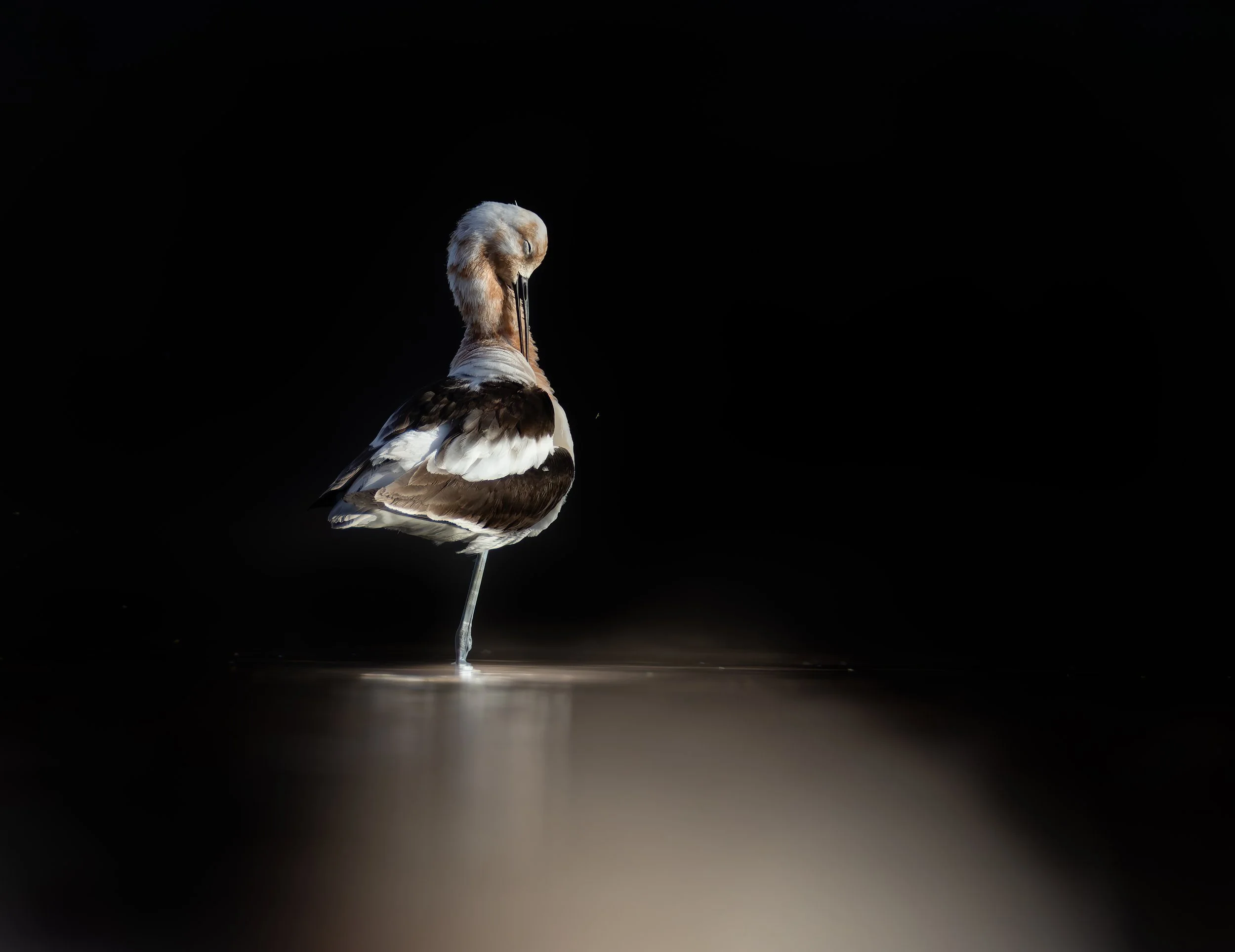
As a wildlife photographer, I spend a considerable amount of time thinking about what separates a photograph that documents a subject from one that communicates something more. A technically excellent photograph of a bird can tell us a great deal about that bird. It can reveal the details of its plumage, its physical characteristics and its behavior. But what happens when we begin to think beyond the subject itself? What happens when we use negative space to communicate solitude, shadows to create mystery, soft light to convey tranquility, or a low perspective to establish a more intimate connection with the subject? The bird hasn't changed. What has changed is how we have chosen to represent it.
This is why I place so much emphasis on slowing down in the field, evaluating the entire scene and becoming more intentional about the photographs we create. I am not simply looking for a bird to photograph. I am looking at the relationships between the subject, the light, the background, the colors and the space surrounding it. Each of these elements becomes part of the creative process. There is a difference between photographing something beautiful and creating a beautiful photograph.
Does Artistic Freedom Have Boundaries?
This is where the conversation becomes particularly interesting. If photography is an art form, should photographers have unlimited creative freedom? Does removing an element, replacing a background or combining multiple photographs make the resulting image any less artistic? Not necessarily. However, I believe there is an important distinction between artistic merit and photographic authenticity.
An image can be a legitimate work of art without being a faithful representation of an observed scene. The issue is not necessarily what the artist creates, but how the artist represents what has been created. This becomes particularly important in wildlife photography, where viewers often assume that the moments, behaviors and interactions they are seeing actually occurred.
Artificial intelligence introduces another layer to this discussion. An entirely AI-generated image may have artistic qualities, but does that make it a photograph? Can something be considered photography when no photographic capture was involved? I believe we need to be able to distinguish between photography, photographic art and digitally generated artwork without automatically dismissing the artistic value of any of them. Creative freedom and artistic integrity do not have to exist in opposition to one another.
Developing the Artist Behind the Camera
We spend a tremendous amount of time as photographers learning about equipment, exposure, autofocus, sharpness and post-processing. These are all important skills, but they are ultimately tools that allow us to express our creative vision. Understanding how to operate a camera is not the same as understanding how to create art.
Developing as a photographic artist requires us to explore the principles of visual design, understand the emotional qualities of light and color, recognize the importance of simplicity and become more aware of what we are communicating through our photographs. It also requires us to develop confidence in our own artistic decisions rather than continually trying to reproduce the work of others or create images that will receive the greatest number of likes on social media.
Artistic development is a personal journey. Not every photograph needs to be a work of art, and there is nothing inherently less valuable about a photograph whose purpose is simply to document a subject. But for those of us who want to explore photography as a form of artistic expression, there is an entire world of creative possibilities beyond the technical aspects of the craft.
Perhaps the most important question we can ask ourselves when we raise our cameras is not whether we have the correct settings, but what we want to communicate through the photograph we are about to make. Are we simply photographing what is in front of us, or are we using what is in front of us to express how we see the world?